Storm Safety
What to Do After a Storm Damages a Tree in Ottawa or Gatineau
A safety-first routing guide for storm-damaged trees: when to call 9-1-1, the electrical utility, 3-1-1, or a private tree crew.
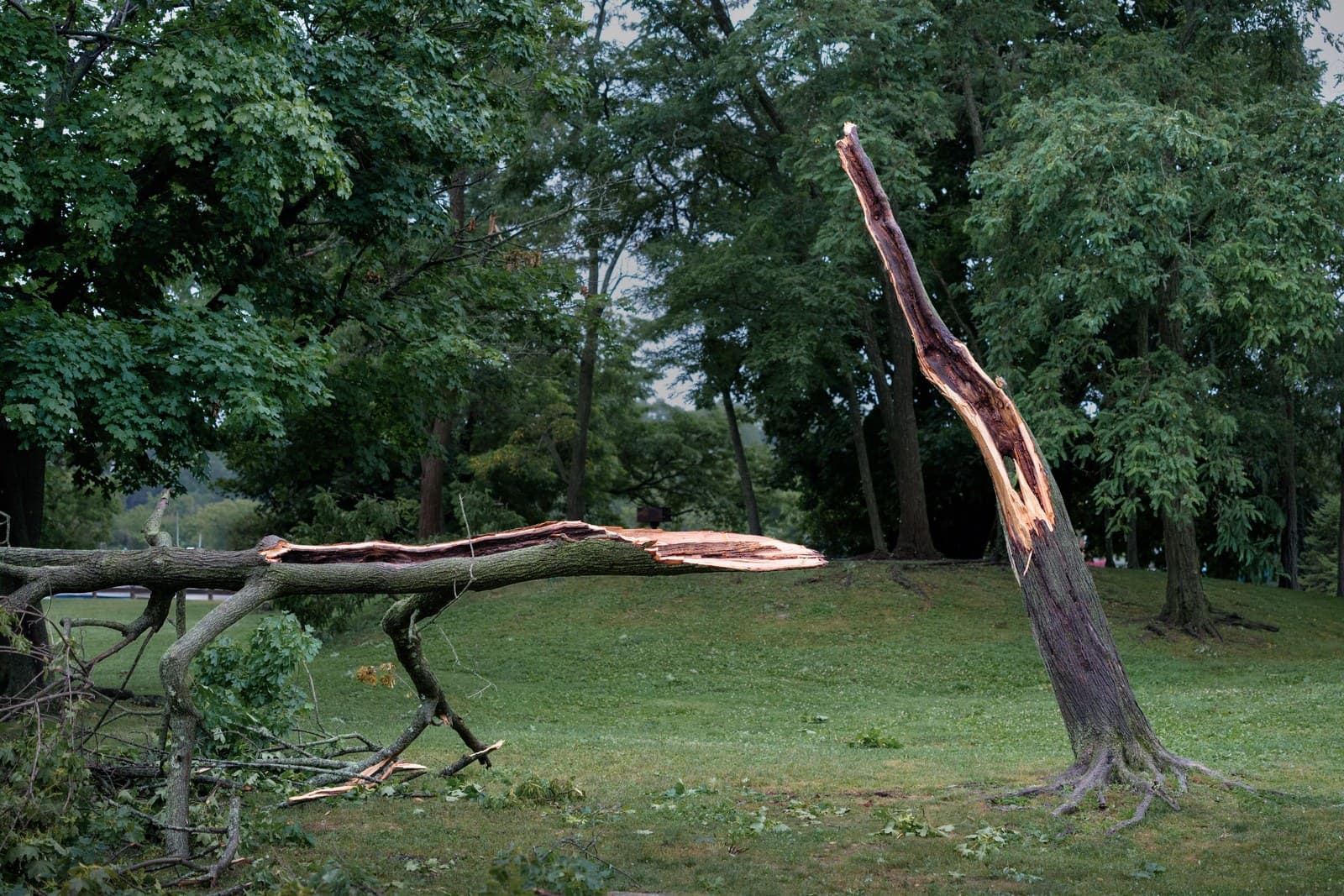
If a storm has split, uprooted, or dropped part of a tree, do not begin by deciding whether it can be saved. Begin by keeping people away and choosing the right call. Call 9-1-1 for fire, injury, a downed power line, or immediate danger to people. Contact the electrical utility when wires or electrical equipment are involved. Use municipal 3-1-1 for a blocked public road or sidewalk, or a tree that may be City-owned. A private tree crew is the next call for work on private property after emergency, utility, and municipal responsibilities are clear.
This article is a routing guide, not a diagnosis. Storm-damaged wood can be suspended, twisted, or carrying loads that are not obvious from the ground. A photograph cannot establish whether a tree is stable, and a quiet tree after the wind stops is not proof that it is safe to approach.
First, create distance and control access
Move people and pets away from the tree, fallen material, and anything the tree is touching. Do not stand beneath hanging branches, walk under a leaning trunk, climb onto a roof, or enter a fenced-off area to inspect the damage. If you can close a gate or warn others without moving closer to the hazard, do that. Otherwise, wait for the appropriate responder.
Do not pull a branch with a vehicle, cut a bent limb, or try to roll a supported trunk. A branch pinned against the ground or another branch can release suddenly when cut. Root plates can also move after an uprooted tree appears to have settled. These are reasons to keep the area clear, not clues for a homeowner to interpret as a diagnosis.
- Stay out of the fall area and away from suspended branches.
- Keep children, neighbours, and pets out of the affected space.
- Do not move branches that touch wires, vehicles, roofs, or public routes.
- Take photos only from a location that was already safe.
Call 9-1-1 for immediate danger
Call 9-1-1 when anyone is injured, there is fire or smoke, a power line is down, or the situation presents an immediate danger to people. Give the exact location and describe what the tree or branch is touching. Say whether people are trapped, whether a road is blocked, and whether wires, sparks, or electrical equipment are visible.
Hydro Ottawa instructs the public to call 9-1-1 immediately for a downed line and then call Hydro Ottawa. It also says to remain at least 10 metres away from a downed wire and anything it touches, including trees, fences, vehicles, and water. Do not touch a person or object in contact with the wire. In Gatineau, follow Hydro-Québec's reporting direction for a tree or large branch on its system, while using 9-1-1 for the immediate emergency.
Contact the electrical utility when wires are involved
Do not ask a general tree crew to investigate branches touching or threatening electrical lines. In Ottawa, contact Hydro Ottawa for guidance and report damaged electrical equipment through its channels. Hydro Ottawa states that overhead lines can cause a fatal shock without direct contact because electricity can arc through the air. Its published distances apply to people, tools, ladders, equipment, and tree branches.
In Gatineau, use Hydro-Québec's safety questionnaire and reporting route. Hydro-Québec says that some pruning and felling near its lines must, by law, be completed by an arborist authorized by Hydro-Québec. That status is specific and must be verified through Hydro-Québec. Hungry Beaver does not claim that authorization in this article.
Never try to identify a safe work zone by approaching with a tape measure. Hydro-Québec tells readers to estimate from the ground and never place a measuring instrument within three metres of the wires. If you are unsure which wire is involved or whether a branch could reach it, stop and ask the utility.
Use 3-1-1 for public routes and possible municipal trees
Contact the municipality when a damaged tree blocks a public road or sidewalk, affects municipal property, or may be City-owned. In Ottawa and Gatineau, 3-1-1 is the practical non-emergency route for municipal questions. Do not assume that a tree beside a driveway or fence is private based on appearance alone.
Ottawa's current post-August 12 storm page says to call 3-1-1, rather than submitting an online request, for a dangerous tree or limb or one blocking a roadway. It also says Forestry Services is handling higher call volumes and will review requests by priority. For a private Ottawa tree that is dead or hazardous and an immediate threat to public health or safety, the City says photos should be taken before removal to document the condition and reason for the permit exemption. That exemption is not a substitute for 9-1-1, utility direction, or a municipal ownership check.
Tell 3-1-1 the address or nearest intersection, what public route is affected, and whether wires or immediate danger are present. Municipal staff determine the City's role. A private crew should not cut a suspected municipal tree or enter a public work area without clear authority.
Call a private tree crew for private-property follow-up
Once immediate danger, electrical hazards, public access, and ownership questions have been routed, a private tree crew can discuss the remaining work on private property. The first conversation should identify the address, what changed during the storm, what the tree is resting on, access limits, and whether another authority has already attended or issued instructions.
Urgent make-safe work and complete cleanup may be separate scopes. A crew may first control access or remove material loading a structure, while complete removal, hauling, stump work, or restoration is planned later. Utilities, permits, weather, equipment access, and daylight can affect what is safely included in each stage. No arrival or completion time should be assumed until the request is reviewed.
For a private-property situation that is no longer an active emergency, Hungry Beaver can review the details and explain the next quote or site-visit step. Call for urgent triage rather than waiting on an online form. Use the form for planned follow-up when the area is stable and the correct authorities have cleared their part.
Record useful information without entering the hazard area
From a safe location, note when the damage happened, whether conditions are still changing, and what is affected. Wide photographs can help a dispatcher or crew understand the setting, but do not move closer for a better angle. Include the whole tree, nearby structures, and access route only when each image can be taken safely.
If property is damaged, contact your insurer and follow its instructions. Keep municipal, utility, and contractor reference numbers. Ask any private provider for a written scope that separates immediate work from removal, debris, stump, and restoration. A tree contractor cannot decide insurance coverage and should not promise a claim outcome.
- Exact address and safe callback number
- Injury, fire, smoke, sparks, or downed-line status
- Public road or sidewalk impact
- What the tree is resting on
- Utility or municipal reference numbers already received
- Safe photos, if available without approaching
Frequently asked questions
Should I call a tree company before the electrical utility?
Not when a tree or branch is touching, leaning on, or may fall into electrical lines. Keep away and contact 9-1-1 for an immediate emergency and the appropriate utility for electrical direction before arranging private work.
Who should I call for a storm-damaged City tree?
Use municipal 3-1-1 for a tree that may be City-owned or affects a public road or sidewalk. Call 9-1-1 first if there is immediate danger, injury, fire, or a downed line.
Can I cut a branch that is no longer moving?
Do not treat a lack of movement as proof that the branch is safe. Storm-damaged material can remain suspended or under tension. Keep clear and have the situation routed or assessed from a safe position.
Will emergency service remove the whole tree and clean everything up?
Not necessarily. Immediate make-safe work, complete removal, debris hauling, stump work, and restoration may be separate scopes depending on utilities, access, permits, weather, and available equipment.
Can photos confirm whether the tree is safe?
No. Photos can help route a request but cannot confirm root condition, hidden damage, changing loads, or a complete risk assessment. Never enter the hazard area to take them.
Sources
Rules and safety guidance can change. Check the current authority page before acting.
After 9-1-1, the utility, and the municipality have handled any part that belongs to them, send Hungry Beaver the property details for a written next step. Call instead of using the form while the condition is urgent.
Request a planned follow-up quote